

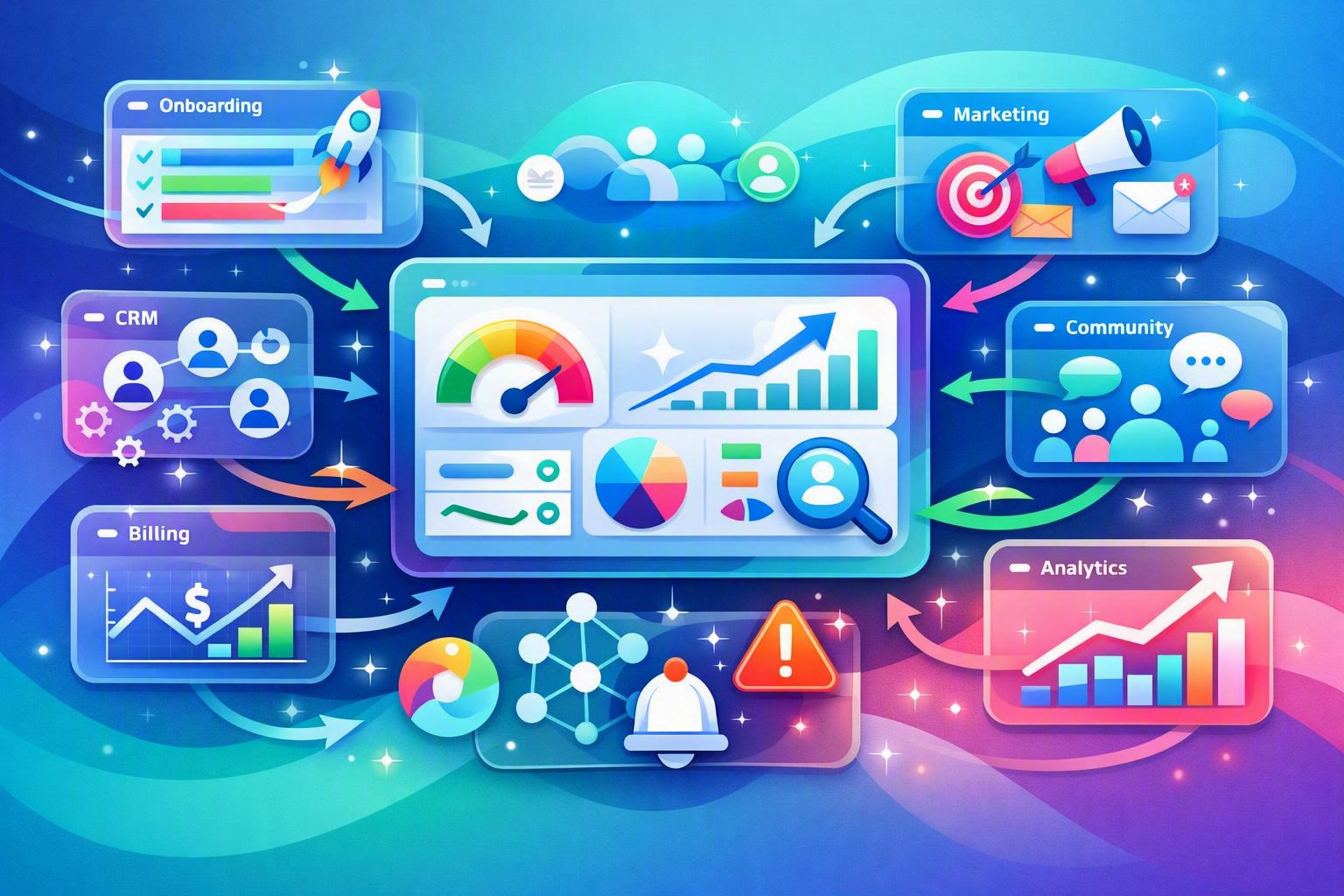
Customer retention strategies for SaaS companies are evolving rapidly in 2026 as small teams face growing pressure to scale revenue without dramatically increasing headcount. Retention is no longer limited to support tickets or renewal reminders. Instead, successful SaaS businesses are building proactive systems that identify churn risks early, communicate customer value consistently, and surface expansion opportunities at the right moment.
The biggest shift is the move toward unified customer visibility. Teams that connect CRM activity, billing behavior, onboarding milestones, and product usage data can respond faster and make smarter decisions with less manual effort. This article explores how modern SaaS teams reduce churn, improve customer engagement, and turn retention into a coordinated growth strategy.
How Modern SaaS Retention Strategies Reduce Churn
In 2026, the strongest retention programs focus on proactive engagement rather than reactive customer support. SaaS teams now monitor onboarding progress, product usage patterns, support interactions, and billing activity to detect risk before customers disengage. This allows smaller teams to intervene early without building large customer success departments.
A common approach involves lightweight health scoring systems that combine signals such as login frequency, feature adoption, renewal timing, and customer feedback. When onboarding stalls or engagement drops, automated workflows trigger reminders or outreach campaigns. High-value accounts may receive direct communication, while automated nudges guide smaller accounts back toward activation milestones.
“Retention improves when SaaS teams respond to customer behavior before churn signals become visible.”
The first 90 days after signup remain especially important. Many SaaS companies now track 7-day, 30-day, and 90-day activation milestones because early product adoption strongly influences long-term retention. Platforms with connected customer data simplify this process by giving teams a complete view of engagement history inside a centralized system.
For example, MainFoundry’s CRM platform helps teams combine customer communication history, product engagement data, and operational context in one place instead of relying on disconnected tools.
Pro Tip: Automated milestone tracking works best when paired with personalized outreach. Customers are more likely to stay engaged when messaging reflects their specific goals and workflows.
Additionally, modern retention strategies depend heavily on clear value communication. Instead of simply highlighting feature usage, successful SaaS teams show measurable outcomes such as workflows automated, projects completed, campaigns launched, or hours saved. Customers are less likely to churn when they can directly connect the product to business impact.
Automation has become essential here because manually producing customer reports every month is difficult for lean teams. MainFoundry’s marketing analytics tools and AI-powered reporting workflows help teams combine operational and engagement metrics into scalable reporting systems.
Using Unified Data to Drive Expansion and Community Growth
Expansion revenue is increasingly viewed as one of the strongest indicators of customer health. Accounts that adopt more features, add seats, and expand into new workflows are typically far less likely to churn. Leading SaaS companies now trigger expansion conversations based on actual customer behavior rather than arbitrary upgrade timelines.
For instance, consistent automation usage, approaching seat limits, or collaboration across multiple departments can signal that an upgraded plan would genuinely improve the customer experience. This creates expansion opportunities that feel relevant and helpful instead of purely sales-driven.
- Usage-based upgrade triggers tied directly to customer adoption patterns
- Renewal conversations supported by measurable customer outcomes
- Automated reminders for accounts nearing subscription or feature limits
- Expansion offers connected to specific workflow needs and operational goals
Connected operational data is what makes these workflows practical. When billing systems, CRM records, product analytics, and marketing engagement remain separated, teams struggle to identify expansion opportunities consistently. MainFoundry’s finance and subscription management tools help unify subscription activity with customer engagement data so renewal and expansion workflows stay coordinated.
In 2026, community engagement is becoming a measurable retention driver rather than a side marketing initiative.
Community-building is also emerging as a major retention advantage for smaller SaaS companies competing with larger platforms. Customers who participate in peer groups, webinars, office hours, and product discussions often adopt features faster and remain subscribed longer. The difference today is that companies are treating community participation as operational data alongside product usage and retention metrics.
Lean teams are finding the most success with focused engagement formats such as Slack groups, recurring customer workshops, and feature-focused user sessions. These environments create meaningful engagement loops where customers learn from each other while staying connected to the broader product ecosystem.
Operational flexibility plays a major role here as well. MainFoundry’s custom workspaces allow teams to build workflows around onboarding, expansion tracking, customer success, and community engagement without relying on fragmented systems.
Key Takeaways
The most effective customer retention strategies for SaaS companies in 2026 are centered around visibility, timing, and automation. Teams that proactively monitor customer health, communicate measurable value, and identify expansion opportunities based on real usage patterns can improve retention without dramatically increasing operational overhead.
The biggest changes shaping retention today include proactive health-score monitoring, automated value reporting, behavior-driven expansion workflows, and measurable community engagement. These systems become significantly easier to manage when customer data is unified across CRM, billing, marketing, and operational workflows.
To explore how unified customer intelligence can support retention workflows, automation, and expansion visibility, visit MainFoundry or connect directly with the team at https://www.mainfoundry.com/contact.
Related Reading
Explore the MainFoundry CRM platform to learn how unified customer visibility supports long-term SaaS retention and expansion strategies.