

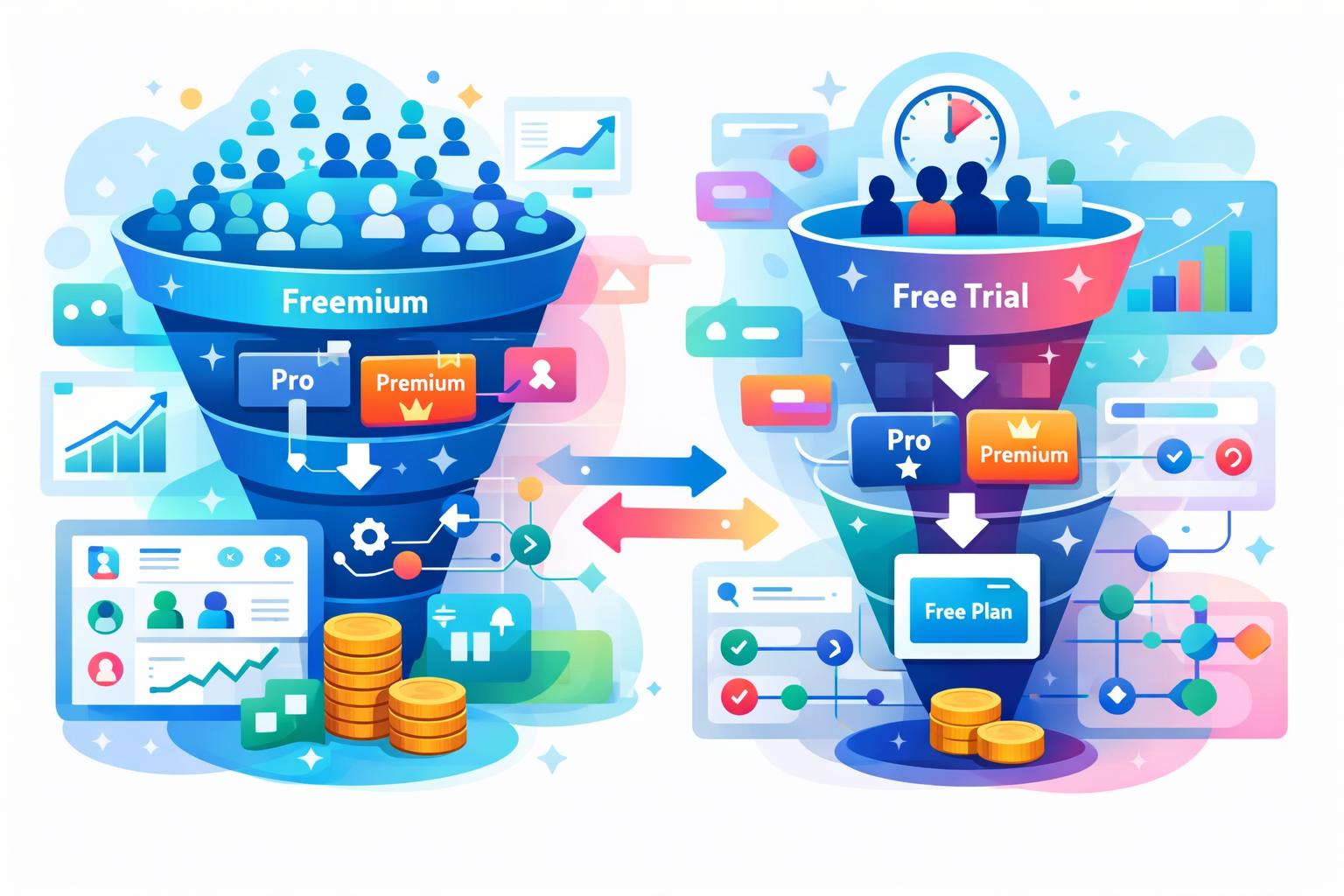
Choosing between freemium and free trial SaaS models affects far more than pricing strategy. The model you adopt shapes customer acquisition costs, onboarding complexity, conversion rates, support requirements, and even how your product team prioritizes features. Two SaaS companies with nearly identical products can experience completely different growth trajectories depending on whether they offer permanent free access or a limited evaluation window.
For product-led growth teams, the real challenge is not deciding which model is universally better. Instead, the decision depends on your product complexity, average contract value, market size, and go-to-market motion. This guide explores freemium vs free trial SaaS benchmarks, how each model changes monetization economics, when hybrid approaches work best, and how platforms like MainFoundry support both models operationally.
Freemium vs Free Trial SaaS Economics and Funnel Performance
Freemium and free trial strategies optimize for different parts of the customer funnel. Freemium models focus on maximizing user acquisition volume by lowering friction almost entirely. Users can sign up quickly, experiment with the product indefinitely, and often invite teammates without immediate purchasing pressure. In contrast, free trials prioritize faster monetization by giving users temporary access to premium functionality before asking them to convert.
The benchmark differences are substantial. Freemium SaaS products commonly convert only a small percentage of users into paying customers, frequently landing in the low single digits. High-performing product-led businesses sometimes reach higher conversion rates, but scale is usually required to produce meaningful revenue. Free trials generally convert a larger percentage of signups because users experience the complete product from day one rather than a restricted version.
Freemium usually maximizes signup volume, while free trials optimize for higher conversion efficiency and faster revenue generation.
This distinction dramatically impacts customer acquisition economics. Freemium products often benefit from lower acquisition cost per signup because barriers to entry remain minimal and organic sharing becomes easier. However, CAC per paying customer can rise significantly when most users never upgrade. Teams may need massive user volume to achieve the same revenue output as a trial-driven SaaS company.
Free trial businesses typically operate in the opposite direction. Acquisition costs per lead may increase because companies invest more heavily in qualified traffic, onboarding support, or demos. Yet stronger conversion rates often improve long-term efficiency. Revenue timing also differs. Trial-based products generate purchase decisions within days or weeks, while freemium monetization frequently occurs months later as users expand usage or collaborate across teams.
“A lower-converting freemium model can still outperform financially if viral adoption and long-term expansion revenue outweigh slower monetization.”
The product itself often determines which model works best. Lightweight collaboration apps, communication tools, and file-sharing platforms can support millions of free users because infrastructure costs remain relatively low. Products with more implementation complexity, including finance software, CRM platforms, or analytics systems, usually require users to experience the full workflow before recognizing value. Restricting those capabilities behind a freemium wall may prevent users from reaching the critical “aha” moment.
Many SaaS companies now use hybrid approaches such as reverse trials. In this structure, users receive temporary premium access before being downgraded to a permanent free tier unless they upgrade. Reverse trials combine broad acquisition with stronger monetization because users first experience the product’s most valuable features before limitations appear.
Choosing the Right SaaS Model and Supporting It Operationally
The best freemium vs free trial SaaS strategy usually depends on four variables: product complexity, average contract value, customer acquisition motion, and total addressable market size. Products that deliver value immediately with minimal onboarding often align naturally with freemium. Collaboration and communication platforms benefit especially from network effects because the product becomes more useful as more users join.
Free trials generally fit products with higher pricing, deeper workflows, or sales-assisted onboarding. B2B SaaS platforms including analytics tools, finance systems, and operational software frequently require complete functionality for proper evaluation. In those environments, trial signups also provide stronger purchase intent signals, allowing sales and customer success teams to prioritize high-potential accounts more effectively.
Pro Tip: Reverse trials often perform well for hybrid product-led growth strategies because users experience premium functionality before downgrade restrictions create urgency to upgrade.
Operational complexity becomes a major consideration as subscription models evolve. Freemium businesses need reliable free-plan management, including feature restrictions, usage limits, downgrade handling, and upgrade tracking. Trial-based companies require precise trial lifecycle controls, such as automated billing triggers, expiration management, and post-trial workflows.
Hybrid models add another layer of complexity. Users may start on a free plan, unlock temporary premium access based on product usage, and later return to limited functionality if they fail to convert. Managing these transitions manually becomes increasingly difficult as subscription logic grows more sophisticated.
Platforms such as MainFoundry simplify these operational challenges through integrated subscription infrastructure. Its subscription and billing management system supports permanent free plans, time-limited trials, upgrades, downgrades, renewals, and usage-based transitions from a single platform.
Additionally, MainFoundry connects monetization data with its unified CRM platform, allowing teams to identify which free accounts evolve into qualified sales opportunities. Marketing teams can also connect acquisition and conversion data through marketing analytics and attribution tools to evaluate lead quality instead of focusing only on signup volume.
For companies refining onboarding and expansion strategies, AI-powered workflow automation can help identify upgrade triggers, automate follow-up sequences, and surface usage patterns tied to successful customer expansion.
Key Takeaways
- Freemium models usually generate higher signup volume but lower paid conversion rates.
- Free trials often produce faster monetization, stronger qualification signals, and shorter payback periods.
- Low-ACV, self-serve products with viral potential frequently align best with freemium strategies.
- Higher-ACV SaaS platforms with onboarding complexity generally perform better with free trials or hybrid approaches.
- Operational success depends on flexible billing, CRM visibility, analytics, and automated lifecycle management.
The most effective SaaS companies treat freemium and free trial decisions as broader growth strategy choices rather than simple pricing experiments. Your onboarding flow, sales motion, CAC targets, and expansion potential should all influence which model you adopt. If you are building subscription workflows for freemium, trial, or hybrid SaaS models, MainFoundry provides a unified way to manage billing, CRM, marketing analytics, and customer operations together.
Related Reading
Explore subscription and billing management to learn how flexible infrastructure supports product-led growth and SaaS monetization strategies.