

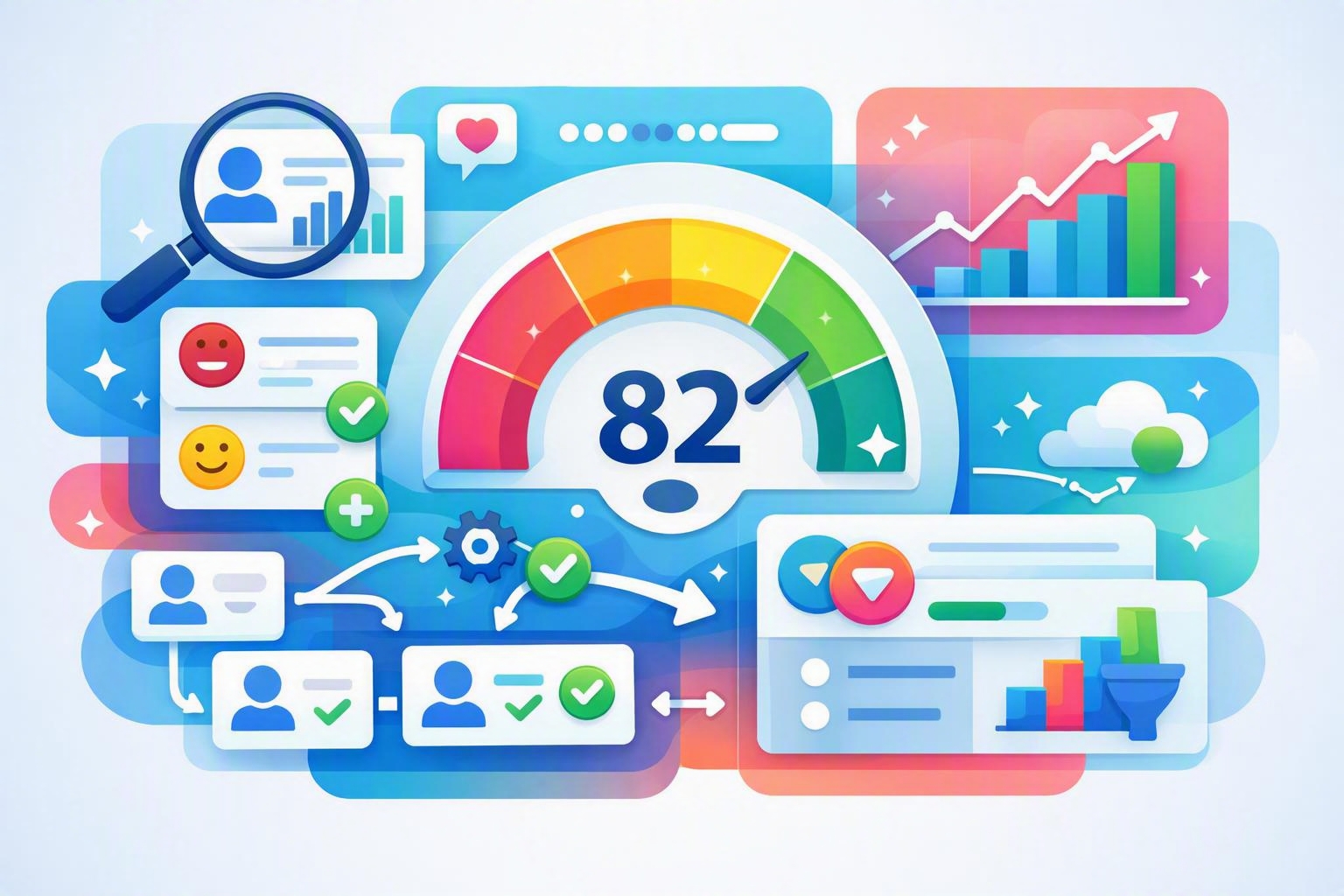
For SaaS companies, customer loyalty is rarely captured by one metric alone. However, Net Promoter Score remains one of the fastest ways to understand how customers feel about your product, onboarding experience, and long-term value. The real advantage comes after the survey, when teams connect feedback to operational workflows that improve retention and expansion revenue.
This guide explains how Net Promoter Score works in SaaS environments, what benchmark ranges actually mean, and why leading software companies combine NPS data with CRM records, product usage, and support history. You’ll also see how SaaS teams use customer sentiment to prioritize outreach, reduce churn risk, and build stronger customer relationships over time.
How Net Promoter Score Works in SaaS
NPS measures how likely customers are to recommend your software to someone else using a 0–10 scale. Customers who score 9 or 10 are considered promoters, while passives score 7 or 8 and detractors score between 0 and 6. SaaS companies calculate the final score by subtracting the percentage of detractors from the percentage of promoters, producing a number between -100 and +100.
The simplicity of the survey is part of its appeal. Leadership teams can track customer sentiment consistently across time periods, while customer success and marketing teams can use responses to guide outreach. Most SaaS businesses run relationship-focused surveys quarterly or semiannually, although some also trigger surveys after onboarding milestones, support interactions, or major feature releases.
“The most valuable part of an NPS survey is often the follow-up question explaining why the customer chose their score.”
Those written responses frequently reveal onboarding friction, missing features, implementation issues, or support concerns that usage analytics alone cannot capture. Additionally, segmentation makes the data far more actionable. A single company-wide score can hide serious dissatisfaction within specific customer groups, including SMB users struggling with onboarding while enterprise accounts remain highly satisfied.
This is why many SaaS teams integrate NPS directly into their CRM infrastructure. Using a unified platform such as MainFoundry’s customer relationship management system, businesses can store responses at both the contact and account level, classify respondents automatically, and trigger workflows tied to customer sentiment.
In SaaS, NPS scores between 30 and 50 are generally considered strong, while scores above 50 are often viewed as world-class.
Benchmarking matters because raw scores can feel abstract without context. Scores below zero usually indicate elevated churn risk, while many SaaS companies operate in the 0–30 range. Research commonly places the median SaaS NPS in the low 30s, with top-performing software brands such as Zoom, Slack, and Snowflake publicly reporting significantly higher scores tied to strong product adoption and customer advocacy.
At the same time, benchmarking only becomes useful when you compare similar customer segments, pricing models, and market categories. A niche enterprise platform should not expect the same customer behavior as a consumer-focused app. Tracking trends over time is often more meaningful than chasing a single benchmark number.
Using NPS Data to Improve Retention and Expansion
The relationship between customer satisfaction and retention is well established, but it is rarely straightforward. Promoters generally churn less often than detractors, adopt additional features more frequently, and contribute more referrals and expansion revenue. Detractors, in contrast, often generate more support complaints and show weaker product engagement.
However, NPS alone is not a complete churn prediction model. Some customers report high satisfaction while quietly evaluating competitors, while others may submit a low score after a frustrating support interaction but still renew because the platform is deeply embedded in daily operations. Mature SaaS organizations treat NPS as one signal within a broader customer health framework.
This broader approach combines emotional loyalty data with operational metrics such as onboarding completion, feature adoption, support escalation frequency, and contract history. Through MainFoundry’s custom business workspaces, SaaS teams can view survey responses alongside account activity and implementation status in one operational dashboard.
Pro Tip: Responding to detractors within one or two business days dramatically increases the value of your NPS program because issues can often be resolved before renewal discussions begin.
Automation also makes sentiment-driven retention programs scalable. Using MainFoundry’s AI-powered workflow platform, teams can automatically assign follow-up tasks after low scores are submitted, personalize outreach based on account history, and notify customer success managers when strategic accounts shift from promoter to passive.
Promoters deserve equal attention because they represent expansion and advocacy opportunities. SaaS companies frequently invite these customers into beta programs, referral campaigns, and testimonial initiatives. In contrast, passives often require education-focused engagement, including feature discovery sessions or tailored onboarding reinforcement designed to increase perceived value.
- Measure NPS consistently using a standardized survey structure and clear customer segmentation.
- Combine sentiment data with onboarding progress, support history, and product engagement metrics.
- Create different workflows for promoters, passives, and detractors to improve retention and expansion outcomes.
- Track trends over time instead of relying only on a single benchmark score.
- Use CRM automation to trigger fast follow-up actions and prioritize high-risk accounts.
The strongest SaaS organizations connect NPS trends directly to operational changes. Product launches, pricing updates, migration projects, and onboarding redesigns often produce measurable shifts in customer sentiment. By monitoring those relationships closely, teams can identify which initiatives strengthen loyalty and which create friction before churn accelerates.
NPS becomes significantly more useful when combined with broader customer intelligence systems. MainFoundry’s marketing analytics and segmentation tools allow teams to create dynamic customer groups based on satisfaction levels, engagement history, and lifecycle stage, making outreach campaigns far more relevant and timely.
Key Takeaways
For SaaS companies, Net Promoter Score works best as a directional loyalty indicator rather than a standalone retention metric. The most effective programs combine customer sentiment with behavioral data, operational workflows, and CRM automation to identify risks and opportunities earlier in the customer lifecycle.
If your goal is improving renewals and expansion revenue, focus on operationalizing NPS data instead of simply chasing a higher score. Consistent measurement, thoughtful segmentation, and rapid follow-up create a stronger foundation for long-term customer success.
To learn how unified CRM systems and workflow automation can support satisfaction-based retention strategies, visit https://www.mainfoundry.com or contact the team at https://www.mainfoundry.com/contact.
Related Reading
Explore MainFoundry’s customer relationship management solutions to see how integrated customer data supports retention, segmentation, and expansion strategies.