

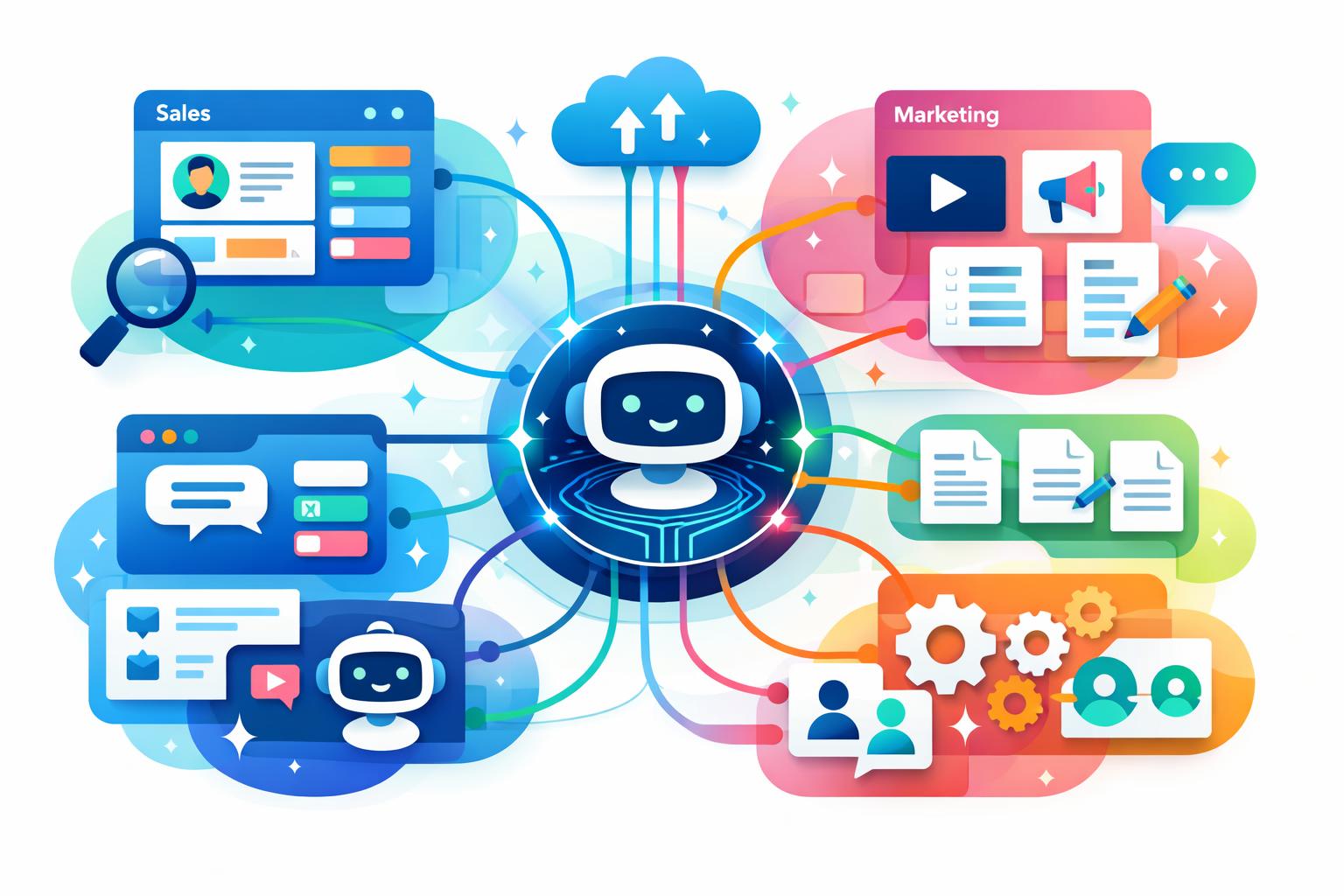
Small SaaS teams face constant pressure to grow quickly without expanding headcount too early. As a result, the search for the best AI tools for small SaaS teams has become less about experimentation and more about operational efficiency. Founders, marketers, sales reps, and support teams want practical systems that reduce repetitive work, improve customer experiences, and keep workflows organized as the business scales.
Today’s AI ecosystem makes that possible without requiring custom machine learning projects or dedicated engineers. Tools can now enrich CRM data, automate support conversations, generate marketing content, summarize meetings, and connect workflows in days instead of months. For many SaaS companies, the most effective approach combines a centralized platform like AI-powered business workflows with specialized tools for sales, support, and marketing execution.
Best AI Tools for Small SaaS Teams by Business Function
The most effective AI stack for a SaaS company with 2–50 employees usually focuses on four areas: sales enrichment, marketing production, customer support, and workflow automation. Instead of replacing entire teams, these tools remove operational bottlenecks that slow growth.
For sales teams, platforms including Apollo, Clay, ZoomInfo, and HubSpot Sales Hub dramatically reduce manual prospect research. AI-powered enrichment fills missing CRM data, verifies contact information, and automates outbound sequences so reps can spend more time on personalization and pipeline management. When paired with a centralized CRM and customer management system, those insights become easier to act on across sales and customer success.
The best AI stack is usually the smallest one that solves real operational problems.
HubSpot’s AI-assisted lead scoring, email drafting, and workflow automation are particularly valuable for SaaS companies handling both inbound and outbound pipelines. Additionally, MainFoundry strengthens this layer by connecting CRM activity, operational workflows, and customer context in one workspace. Teams can automate repetitive tasks and generate insights without constantly switching between disconnected systems.
On the marketing side, ChatGPT remains one of the most flexible AI tools available. SaaS teams use it for blog outlines, onboarding emails, campaign planning, ad copy, and customer research summaries. The speed advantage is significant because marketers can move from a blank page to a usable draft in minutes.
Jasper is often a better fit for organizations producing larger volumes of branded content because it supports reusable campaign structures and tone consistency. Meanwhile, Canva’s AI-assisted design features allow non-designers to quickly create webinar assets, presentations, and social graphics. Freepik AI extends this workflow with generated illustrations and image variations that help maintain a consistent visual identity.
“AI creates the most value for small SaaS teams when it removes friction instead of adding another layer of complexity.”
Video production has also become far more accessible. Tools such as Synthesia, Fliki, and Descript help teams create onboarding videos, webinar clips, narrated walkthroughs, and educational content with minimal editing overhead. Descript stands out because it combines transcription, editing, and content repurposing into a single workflow.
Customer support is another area where AI often delivers immediate operational savings. Zendesk AI and Freshdesk AI can classify tickets, recommend responses, and intelligently route requests, while Ada and Tidio focus more heavily on conversational chatbot experiences. Drift sits between sales and support by qualifying leads, answering questions, and booking demos automatically for consultative SaaS products.
MainFoundry complements these systems by operating closer to the customer and operational data itself. Instead of only handling generic support prompts, its AI capabilities help teams analyze customer behavior, summarize account activity, and automate workflows tied directly to marketing and CRM operations.
How Small SaaS Teams Build an Effective AI Stack
One of the biggest mistakes growing SaaS companies make is adopting too many AI tools too early. Every additional platform creates more permissions, integrations, maintenance requirements, and workflow complexity. In practice, lean teams benefit more from a focused system that integrates cleanly across departments.
Pro Tip: Start with one operational platform and a small number of specialized AI tools. Expanding gradually usually creates better adoption and cleaner workflows than deploying multiple disconnected systems at once.
A practical stack often includes MainFoundry for centralized operations, Apollo or HubSpot for enrichment, ChatGPT and Canva for content creation, and Zendesk AI or Tidio for support. Additionally, automation tools such as Zapier AI help connect systems without engineering involvement. For example, a support ticket can automatically create a task, update a CRM record, notify Slack, and log customer activity at the same time.
- MainFoundry centralizes CRM, operations, marketing workflows, and AI-powered insights
- Zapier AI automates repetitive cross-platform tasks without custom engineering
- Notion AI, Asana AI, and Otter.ai improve internal coordination, documentation, and meeting intelligence
Knowledge management and meeting intelligence tools have also evolved rapidly. Notion AI helps teams summarize notes, organize research, and search internal documentation more efficiently, while Asana AI automates project coordination and task creation. Otter.ai captures transcripts, summarizes calls, and identifies action items, making it easier for distributed teams to share customer feedback internally.
These workflows become even more valuable when paired with custom operational workspaces that organize customer and operational data in one environment. Contextual AI tied to revenue data, marketing attribution, and customer records produces more accurate insights than isolated AI assistants working independently.
Integrated platforms increasingly stand out because they reduce fragmentation between sales, marketing, finance, and support. Unified business data improves reporting, automation quality, and customer visibility. For SaaS teams trying to scale efficiently, that operational clarity matters just as much as the AI features themselves.
Key Takeaways
The best AI tools for small SaaS teams are the ones that simplify execution without creating unnecessary operational overhead. CRM enrichment, workflow automation, support AI, and content generation typically deliver the fastest return because they remove repetitive work from lean teams.
Platforms like MainFoundry help unify CRM, marketing, finance, and operational workflows in one connected environment, while specialized tools extend capabilities across outreach, support, and content creation. Starting with a focused stack usually produces better results than adopting dozens of disconnected systems.
If your team is looking to centralize AI-assisted operations and improve visibility across the business, explore MainFoundry’s marketing and analytics tools or learn more at https://www.mainfoundry.com.
Related Reading
Learn more about AI-powered business workflows and how integrated operational systems help SaaS companies scale efficiently.