

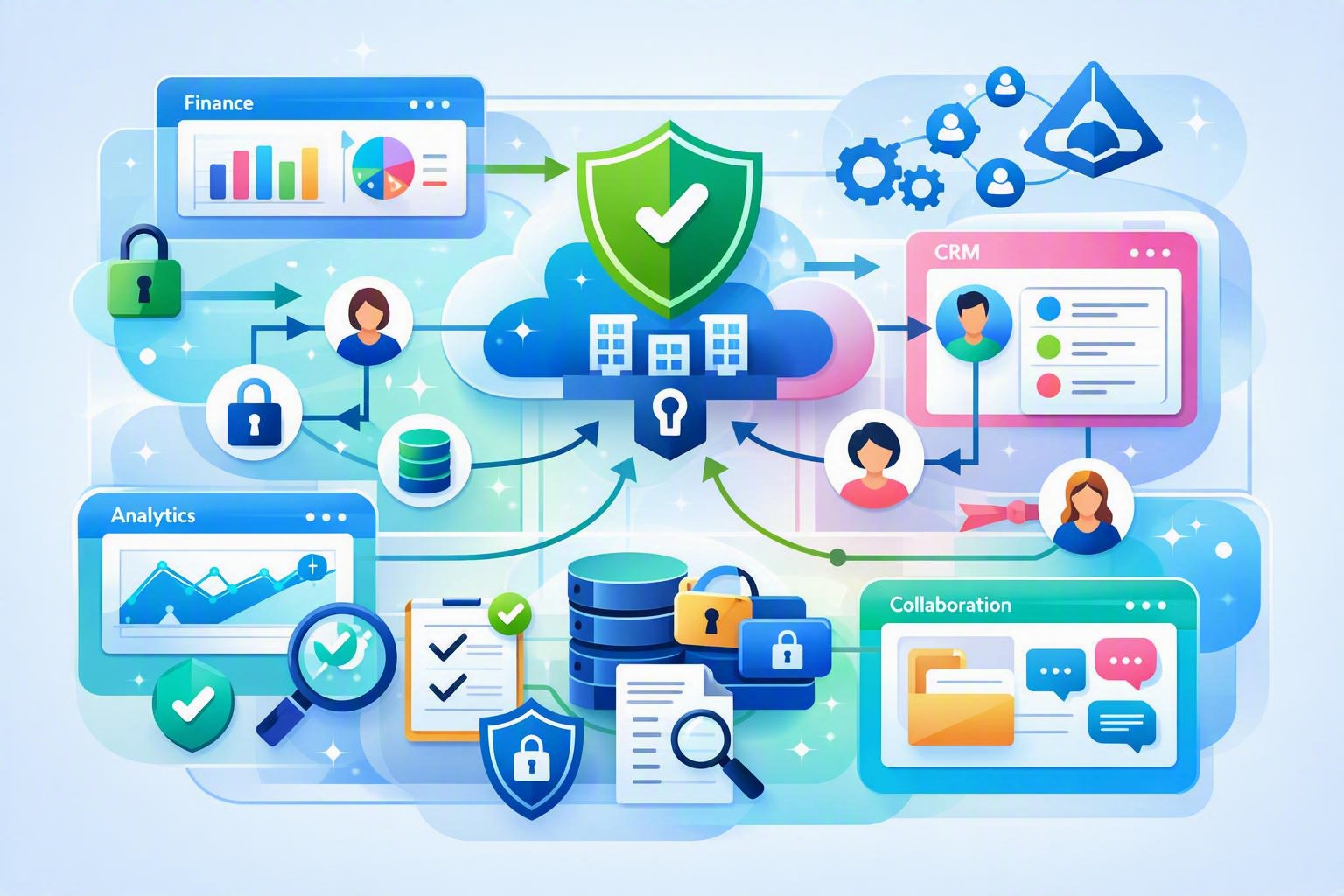
As businesses move CRM data, finance operations, analytics, and collaboration into shared cloud environments, controlling access has become one of the most important parts of SaaS security. Teams need systems that protect sensitive information without creating friction for employees who rely on fast access to tools and records every day. That balance becomes harder as organizations scale across departments, regions, and customer environments.
This is where role-based access control, commonly known as RBAC, plays a central role. Instead of assigning permissions individually to every user, organizations define roles tied to job responsibilities and apply permissions consistently across systems. In this guide, you’ll learn how RBAC works in SaaS environments, why tenant-aware authorization matters, and how platforms such as MainFoundry combine centralized policies, Azure AD integration, and audit-ready controls to support secure business growth.
How Role-Based Access Control Works in SaaS
In a SaaS platform, RBAC revolves around roles, permissions, and resources. Roles represent job functions, permissions define allowed actions, and resources are the systems or records users interact with. Rather than manually assigning dozens of privileges to every employee, administrators grant a predefined role that already contains the correct authorization rules.
This structure becomes especially important in multi-tenant software. Every tenant must remain isolated from every other organization using the platform, which means authorization checks need to include tenant context at all times. Whether a user exports billing records, updates a CRM opportunity, or edits a project workspace, the system must validate both identity and tenant ownership before returning data.
“Strong RBAC is not just about limiting access. It creates consistency, auditability, and predictable security behavior across every part of a SaaS platform.”
Most SaaS companies operate effectively with a relatively small number of clearly defined roles. Typical examples include Tenant Admin, Workspace Admin, Contributor, Viewer, and Billing Admin. The goal is to keep authorization manageable while following the principle of least privilege, meaning users receive only the access required to perform their responsibilities.
For example, a sales representative may update deals inside a CRM but should not be able to export an entire customer database. Similarly, a finance employee might manage invoices without gaining access to security settings or marketing analytics. These boundaries reduce accidental mistakes and limit damage if credentials are compromised.
Pro Tip: Mature SaaS applications enforce authorization at the API layer, not only in the frontend interface. Hiding buttons or menu items does not prevent unauthorized requests if backend validation is inconsistent.
Unified business platforms introduce additional complexity because multiple departments operate inside the same environment. A system combining CRM, marketing, finance, and collaboration tools must apply permissions consistently across every module. MainFoundry addresses this challenge through centralized authorization policies that evaluate requests before actions are allowed or data is returned. Its tenant-aware controls extend across CRM records, financial operations, and customizable workspace management environments.
Additionally, many organizations now integrate SaaS identity management directly with enterprise providers such as Azure AD. Through SSO and automated provisioning, directory groups map directly to application roles so access changes happen automatically when employees join, move departments, or leave the company. MainFoundry supports these workflows with centralized identity-aware controls and Azure AD integration across its operational platform.
Why RBAC Matters for Security and Compliance
The benefits of RBAC extend far beyond convenience. Structured authorization reduces operational risk by limiting unnecessary access and creating accountability around sensitive actions. If a low-privilege account is compromised, the attacker’s activity remains constrained by the assigned role rather than exposing the entire organization.
Tenant-aware RBAC dramatically reduces security exposure by limiting visibility, exports, deletions, and administrative actions to only the users who truly require them.
This becomes even more important in platforms that centralize customer records, invoices, operational workflows, and internal collaboration. Without clear authorization boundaries, employees often accumulate excessive access over time. In contrast, centralized RBAC keeps permissions predictable and easier to review.
Compliance standards such as SOC 2 and ISO 27001 also emphasize controlled provisioning, separation of duties, audit logging, and recurring access reviews. RBAC supports these requirements by creating repeatable and documented permission structures. Quarterly reviews become manageable because administrators can evaluate standardized roles instead of auditing hundreds of one-off permission combinations.
Auditability is another critical factor. Mature SaaS systems log administrator activity, exports, permission changes, and privileged operations so organizations can investigate incidents and demonstrate governance controls during security audits. MainFoundry incorporates these enterprise-grade controls throughout its platform, including tenant isolation and centralized authorization enforcement. Organizations evaluating advanced governance capabilities can review additional details on the platform’s security architecture.
Another important distinction is separating subscription entitlements from user roles. Pricing tiers should determine available product features, while RBAC controls what each individual user can actually do inside those features. Combining these concepts often leads to over-permissioned accounts and inconsistent authorization behavior.
Organizations managing customer relationships at scale also benefit from consistent permissions across operational systems. MainFoundry applies centralized access controls across CRM, finance, analytics, and collaboration tools, helping teams maintain visibility boundaries while still working inside a unified platform. You can explore the platform’s customer management capabilities through its CRM solution.
Key Takeaways
A strong SaaS RBAC strategy starts with simplicity and consistency. Organizations should define practical roles based on real job functions, enforce authorization centrally across APIs and databases, and maintain tenant-aware controls throughout the platform. Automated identity provisioning through Azure AD and detailed audit logging further strengthen operational security while reducing administrative overhead.
- Use least-privilege defaults to reduce unnecessary access and lower security risk.
- Centralize authorization policies to avoid inconsistent security logic across applications.
- Separate subscription plans from user roles to maintain clean permission boundaries.
- Automate joiner-mover-leaver workflows through identity provider integrations such as Azure AD.
As SaaS platforms continue consolidating business operations into unified systems, RBAC becomes foundational for both scalability and governance. MainFoundry combines centralized RBAC, audit-ready controls, Azure AD integration, and tenant-aware permissions across CRM, finance, analytics, and custom workspaces. To explore the full platform, visit MainFoundry or connect directly through the contact page.
Related Reading
Learn more about enterprise-grade governance and tenant isolation through MainFoundry’s security and compliance capabilities.