

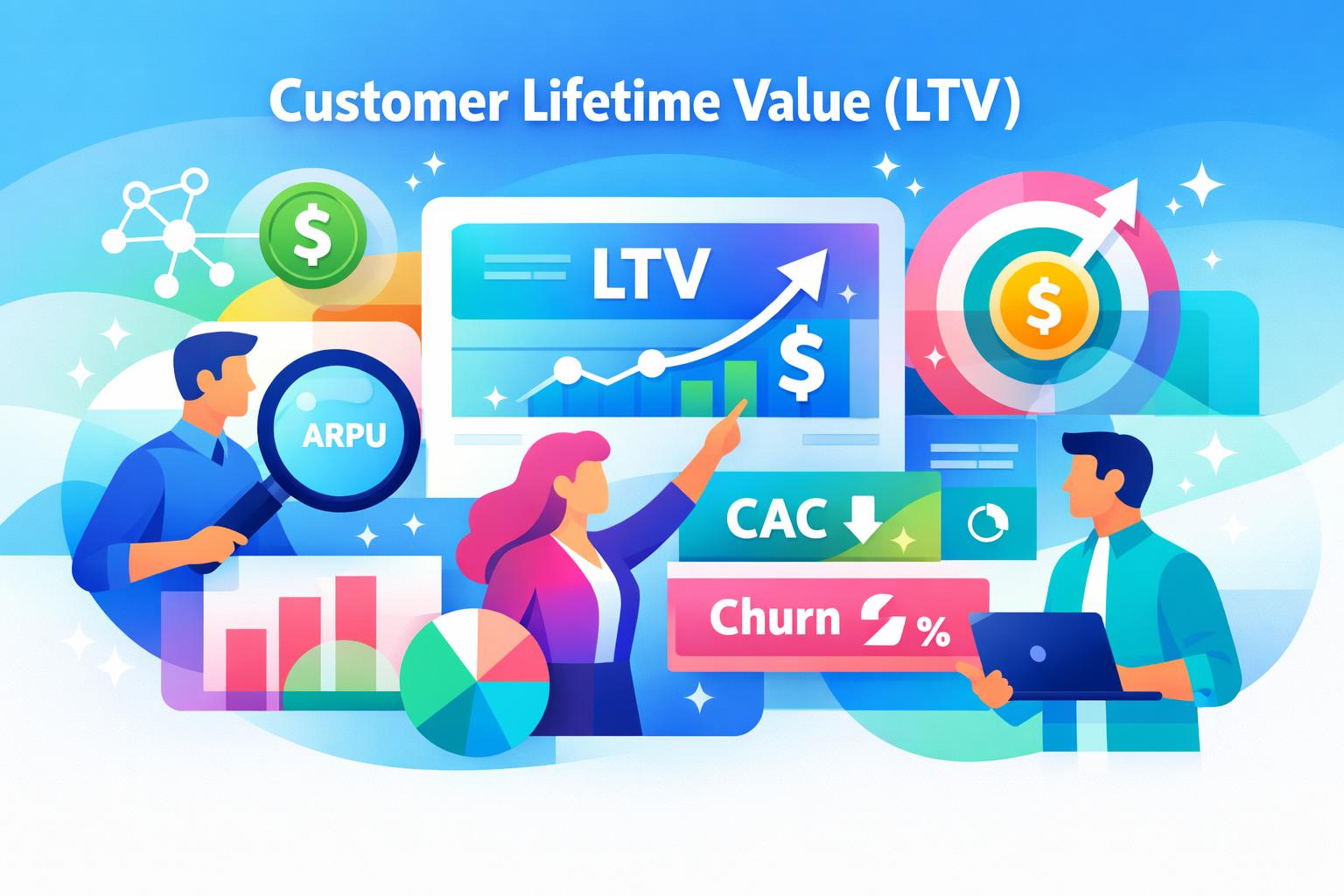
Understanding customer lifetime value (LTV) is essential for every SaaS founder and finance lead aiming to drive sustainable growth. Yet, many teams still rely on rough estimates or outdated formulas that fail to reflect modern subscription dynamics. This guide explores how SaaS companies can calculate, interpret, and improve LTV using both simple and advanced methods. You’ll learn how to apply LTV to strategic decisions, compare it against customer acquisition cost (CAC), and identify actionable steps to grow lifetime value through better retention, pricing, and data integration.
How to Calculate Customer Lifetime Value for SaaS Companies
At its core, customer lifetime value measures how much gross profit a typical customer contributes before they churn. SaaS businesses rely on three core metrics: average revenue per user (ARPU), gross margin, and churn. When these inputs are consistent, LTV becomes a reliable planning tool rather than a vanity metric. ARPU represents revenue, gross margin accounts for delivery cost, and churn defines customer duration.
The simplest calculation is to multiply ARPU by gross margin and divide by churn rate. For instance, $100 monthly revenue at 80% margin and 5% churn gives an approximate LTV of $1,600. While easy to explain, this method assumes constant churn and revenue—conditions rarely true for fast-growing SaaS products. As your company matures, cohort-based and predictive models provide more depth and accuracy.
Cohort-based LTV groups customers by factors such as signup date, plan type, or acquisition channel. Tracking these cohorts helps identify distinct retention and expansion patterns—for example, enterprise customers expanding steadily while SMB customers churn faster. Dashboards like those in MainFoundry’s finance suite automate this analysis, freeing teams from manual tracking and ensuring insights remain actionable.
“Predictive LTV provides a forward-looking view of revenue potential, turning historical data into actionable forecasting.”
Predictive models use historical churn, expansion, renewal rates, and even customer engagement to estimate future value. They often adjust for net revenue retention, including upsells and expansions, not just lost accounts. This approach suits SaaS companies with usage-based pricing and dynamic expansion cycles. While predictive LTV demands clean data, it offers powerful forecasting for budgeting and long-term growth planning.
LTV:CAC Benchmarks and Strategies to Increase SaaS LTV
Once your LTV is solid, compare it against CAC. A healthy LTV:CAC ratio is typically 3:1, meaning you earn three dollars for each dollar spent acquiring a customer. Ratios below this threshold signal issues in retention, pricing, or acquisition strategy. However, even strong ratios can mask challenges if payback periods stretch too long, straining cash flow. Modern finance dashboards combine LTV with CAC payback and net revenue retention to reveal these nuances.
A strong LTV:CAC ratio means sustainable growth—when paired with fast payback and rising retention.
Improving LTV involves enhancing its key drivers: churn, ARPU, and gross margins. Companies succeed when they connect these levers across product, customer success, and finance workflows. Tools like MainFoundry’s subscription dashboard link billing, churn, and expansion data in real time, helping teams pinpoint high-value actions.
- Reduce churn through improved onboarding, customer success, and proactive support that keeps users engaged.
- Grow ARPU by enabling upsells, expansion plans, or usage-based pricing tied to customer value.
- Enhance margins by streamlining infrastructure and controlling service delivery costs as scale increases.
- Apply predictive insights to identify churn patterns early and coordinate marketing or success outreach effectively.
These tactics often compound—reducing churn also accelerates expansion because satisfied customers upgrade faster. Integrated data systems ensure these relationships are visible and actionable, preventing decisions based on incomplete information. Segmenting by customer type and motion (B2B vs. consumer, self-serve vs. sales-led) adds an essential layer of precision when applying LTV metrics to strategic planning.
Key Takeaways
Customer lifetime value is most powerful when consistently calculated and operationalized. Start with simple formulas but evolve toward cohort and predictive approaches as data matures. Use LTV jointly with CAC and retention metrics to create a full picture of sustainable growth. Focus improvement efforts on churn, expansion, and margin optimization for maximum impact.
- Choose an LTV method that fits your company’s stage and data quality.
- Track LTV alongside CAC payback and net revenue retention for deeper insight.
- Centralize subscription, churn, and revenue analytics for team-wide visibility.
- Leverage predictive tools to turn lifetime value into an operational growth metric.
Related Reading
Learn more about balancing growth metrics in SaaS by visiting MainFoundry’s finance and subscription insights to see how unified data drives smarter planning.