SaaS Go-to-Market Models That Scale with CRM
 Jørgen Wibe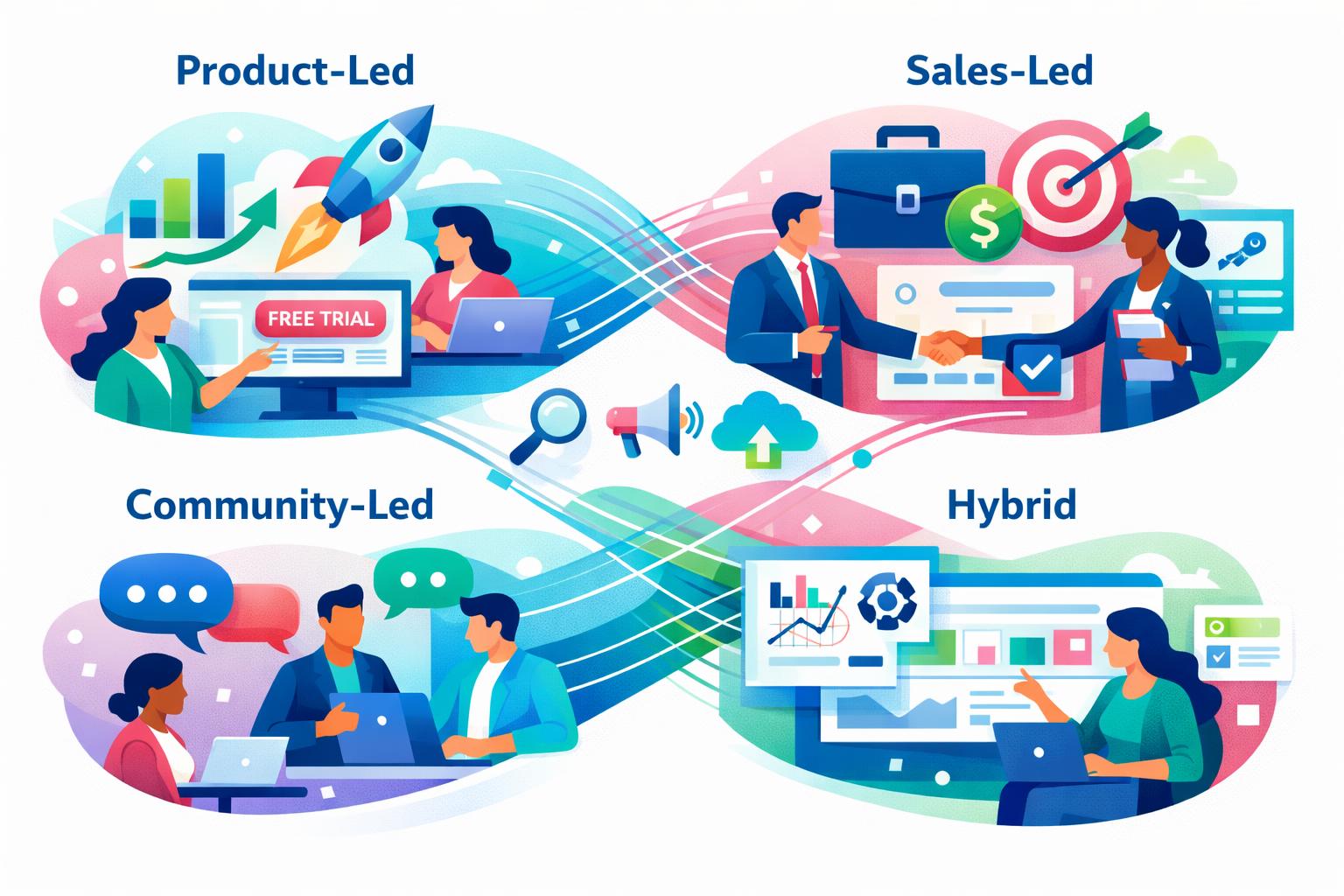
A successful SaaS go-to-market strategy isn’t about chasing trends; it’s about matching how you sell with how your buyers actually buy. Whether you’re launching a freemium app or scaling an enterprise platform, your approach must fit your product’s complexity, average contract value (ACV), and buyer journey. This guide explores four proven SaaS go-to-market models—product-led, sales-led, hybrid, and community-led—breaking down when each works best and how integrated CRM and marketing systems enable them to scale efficiently.
Understanding Core SaaS Go-to-Market Models
Product-led growth (PLG) thrives on product experience. It works when users can discover value independently through a free trial or freemium offering and convert without needing a demo. PLG suits lower-ACV products—typically under $10K annually—where buying decisions are fast and individual. The success of this model relies on rich product analytics, behavioral insights, and a clear understanding of engagement triggers.
Teams often underestimate how much data discipline PLG demands. Visibility into user actions—what features drive activation, where users drop off, and when conversion intent emerges—requires tight integration between analytics and marketing automation. A unified CRM, such as those featured in MainFoundry’s CRM platform, helps map activity to lifecycle stages and conversion sources, ensuring marketing knows what truly drives sign-ups and retention.
Sales-led growth (SLG), by contrast, dominates in higher-ACV environments—usually above $25K—where multiple stakeholders, procurement reviews, and ROI justifications come into play. These buyers expect personalized outreach, detailed demos, and an expert to guide technical and business assessments. A robust CRM is the sales team’s backbone here, managing complex deal cycles, organizing touchpoints, and providing visibility across decision-makers.
For instance, MainFoundry’s integrated marketing tools help bridge marketing efforts with CRM data, eliminating silos that often slow handoffs. This enables sales teams to track engagement chronologically while marketing can measure campaign influence throughout the pipeline.
“Your go-to-market model should align with how customers prefer to buy, not how your competitors choose to sell.”
Hybrid models blend these two worlds, combining self-serve onboarding with sales-assisted expansion. This structure dominates mid-market SaaS, typically with ACVs between $5K and $25K, where frictionless product access matters but larger accounts still require personalized support. The challenge in hybrid setups is coordination—syncing product data with CRM workflows so that sales teams see when users are ready to upgrade or expand.
Additionally, community-led strategies are rising as an influence layer across all models. Community-led growth (CLG) builds authentic advocacy and trust before a sales conversation ever starts. For SaaS brands targeting technical or niche professional audiences, a dedicated community accelerates onboarding, reduces churn, and strengthens brand authority. Flexible CRM structures like custom workspaces help track community engagement alongside leads and opportunities.
Choosing a Scalable Model for Your SaaS Business
The “right” go-to-market strategy emerges from constraints—your ACV, buyer complexity, and product maturity—not from ambition alone. Early signs of product-market fit, such as renewal strength or organic referrals, matter more than top-of-funnel volume. Without a strong foundation, scaling any motion will multiply inefficiencies instead of value.
In general, products priced under $5K fit best within a product-led motion. Offerings between $5K and $25K often benefit from hybrid setups, and enterprise solutions above $25K almost always demand a sales-led approach. Regardless of model, success depends on operational readiness—clear buyer definitions, measurable ROI alignment, and continuous data flow between marketing, sales, and finance.
Data continuity across systems is the most underestimated success factor in SaaS go-to-market execution.
Many growth challenges stem from fragmented systems that disconnect marketing campaigns from CRM visibility or product analytics from revenue outcomes. Modern SaaS teams increasingly resolve this with platforms that unify these layers—bringing together CRM, subscription management, marketing performance, and team collaboration. Learn how alignment like this accelerates growth through MainFoundry’s billing integrations and all-in-one environment.
Key Takeaways
- Your ACV and buyer complexity determine the most effective go-to-market model—avoid copying what worked for someone else.
- Product-led, sales-led, hybrid, and community-led motions all work when operational data flows seamlessly across teams.
- Hybrid approaches dominate modern SaaS because they balance efficiency with scalability.
- Platforms like MainFoundry streamline CRM, analytics, and marketing into one system, reducing friction in execution.
- Start by mapping your customer journey, identifying self-serve opportunities, and closing data gaps before scaling further.
Related Reading
Discover how integrated marketing and CRM tools shape SaaS growth in Building a Data-Driven SaaS Marketing Engine.