

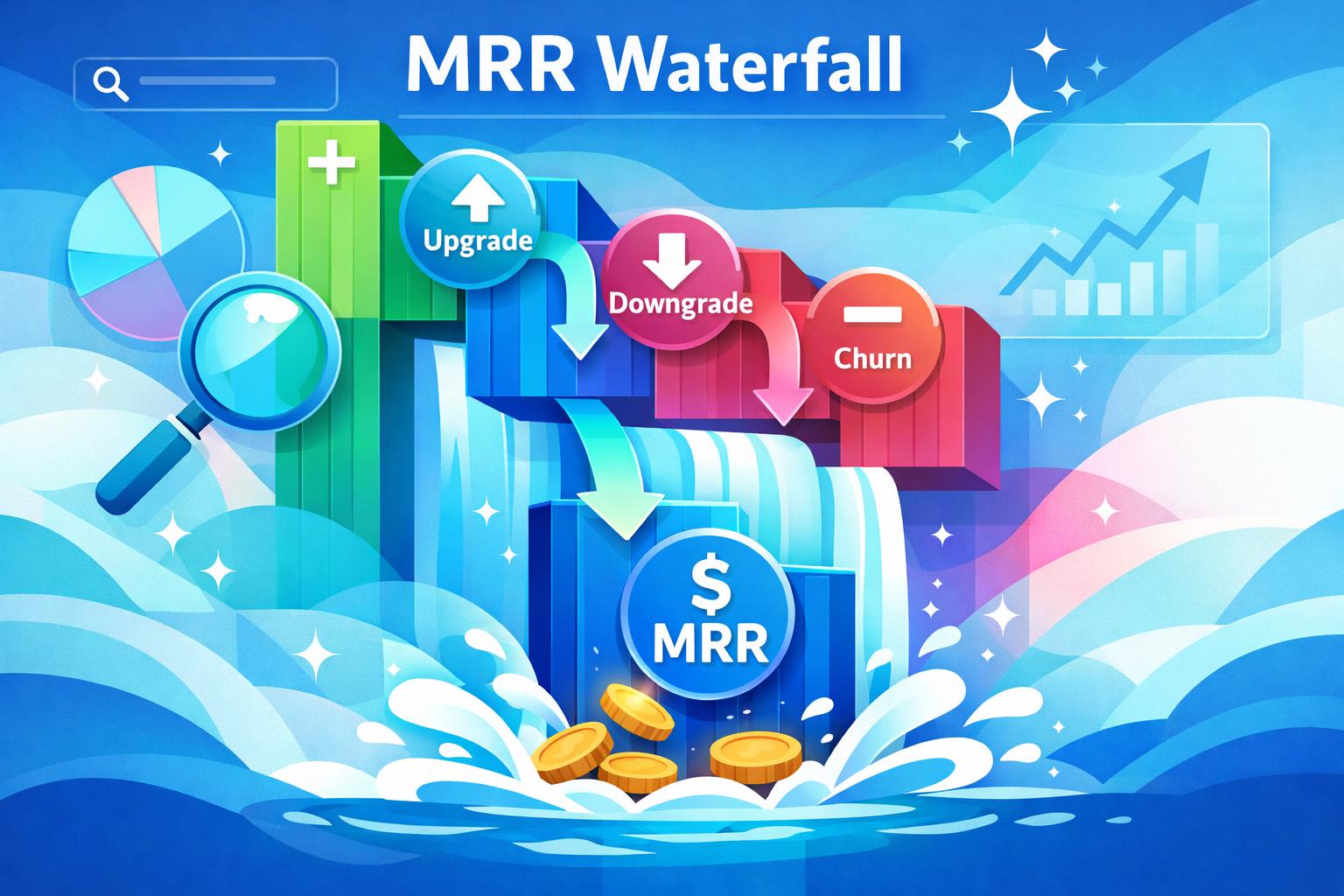
If you’ve ever looked at your monthly recurring revenue and wondered what’s really driving changes, the MRR waterfall is your roadmap to understanding it. Instead of seeing revenue as a single number, this report breaks down every gain and loss — new subscriptions, upgrades, downgrades, and churn — showing where growth is truly coming from. In this post, you’ll learn how an MRR waterfall works, which components reveal the most about your subscription health, and how to build one you can trust for accurate, actionable insight.
How the MRR Waterfall Reveals Subscription Dynamics
At its core, an MRR waterfall shows how your recurring revenue moves from one period to the next by categorizing what’s added, lost, or changed. Starting MRR plus new gains minus losses should equal the closing MRR, giving a clear view of performance drivers. This method highlights which customer actions and behaviors are fueling or slowing growth.
The standard breakdown typically includes new MRR from new customers, expansion MRR from existing customers upgrading, contraction MRR from downgrades, and churn MRR representing full cancellations. Some businesses also track reactivation MRR to count customers who return after canceling. Together, these categories prevent false optimism by showing whether growth comes from net new revenue or masking steep losses.
For example, strong new MRR may look good on the surface but could be offset by high churn or contraction. Expansion MRR, on the other hand, is a powerful indicator of product value since it reflects how much existing customers are willing to invest more. Tracking contraction and churn early provides time to address declining engagement before it becomes unrecoverable loss.
“An accurate MRR waterfall transforms guesswork into clarity by showing not just that revenue changed, but why it changed.”
When connected to systems like subscription and billing management in MainFoundry, these metrics automatically align with customer and financial data. This allows teams to see MRR changes at both the aggregate and customer levels — turning data from static reports into operational insights.
Building an MRR Waterfall You Can Trust
Creating a reliable waterfall starts with clean data. Begin by capturing true monthly recurring revenue snapshots at the start and end of each period. Normalize annual or prepaid contracts into monthly equivalents, and exclude one-time fees to ensure consistency. Once you have those baselines, track every customer-level change precisely by categorizing events correctly — new customer, upgrade, downgrade, or cancellation.
After categorization, reconcile your data. If starting MRR plus gains minus losses doesn’t equal ending MRR, something is likely missing or misclassified. Common culprits include mid-cycle price adjustments or late updates to cancellations. Visualization is the final and most insightful step, typically using a waterfall chart that visually depicts how each event contributes to the net change in recurring revenue.
Pro Tip: Tie your MRR data directly to customer accounts in your CRM to identify which accounts are expanding, contracting, or leaving. Platforms like MainFoundry CRM simplify this by linking financial and customer insights in one place.
When done right, your MRR waterfall becomes more than a finance report — it becomes a growth management tool. Teams can focus conversations around clear levers like reducing churn, improving onboarding for new customers, or promoting expansions through better value realization. For businesses seeking sustainable growth, this level of clarity often matters more than top-line speed alone.
Key Takeaways
- An MRR waterfall explains not just how much revenue changed, but why it changed across subscriptions.
- Expansion and contraction MRR often reveal deeper performance health than new revenue alone.
- Clean definitions and consistent timing are essential to reconciling MRR accurately.
- Connecting finance, sales, and customer data inside one system, such as MainFoundry, reduces reporting friction and improves reliability.
By adopting this structured approach, your revenue tracking goes from reactive reporting to proactive management. Explore how MainFoundry unites subscription analytics and CRM data to make recurring revenue easier to understand and act on, or reach out directly at MainFoundry Contact for tailored guidance.